Wednesday, April 22, 2020

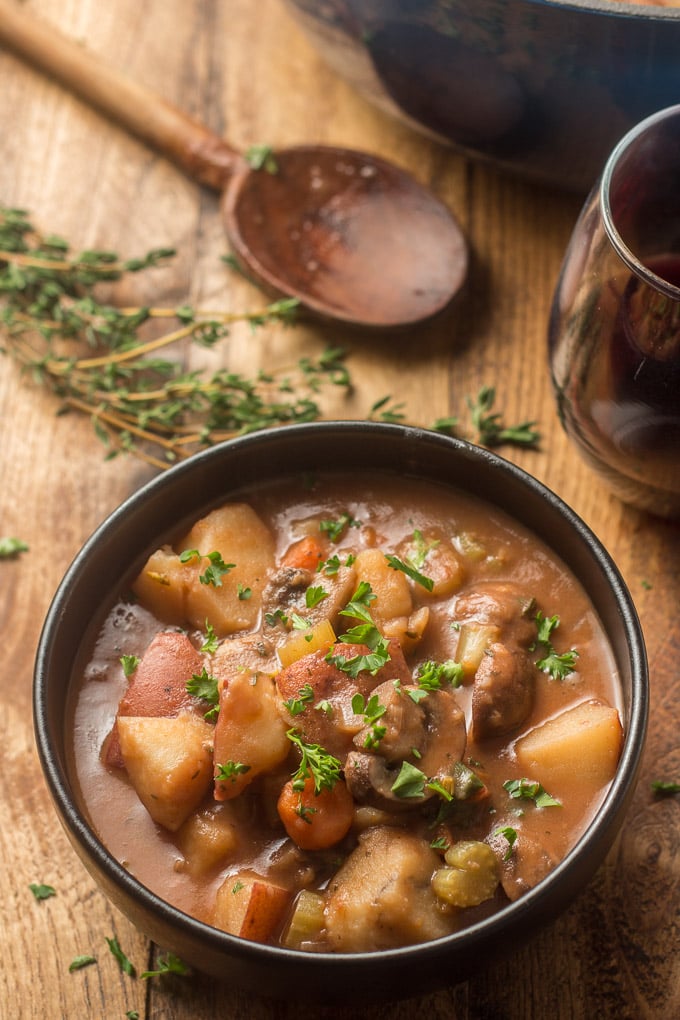
Recipe: Beefless Stew

I didn't even adapt this one much, since Connoisseurus Veg did such an excellent job... but here, have the link and my notes.

Vegan Beef Stew

Now, for all I call it "Beefless Stew", mine actually has more beef in it than the original, vegan recipe.  I'm not vegetarian or vegan myself, and when I discovered that beef broth (and chicken broth, for that matter) contains very little protein, I decided I might as well make use of what flavor it can provide.

So for starters, I use a quart of beef stock instead of veggie broth.  It means I can bypass the Marmite which is recommended for its savory quality; a good beef broth has that.  I also skip the liquid smoke, but mostly because I'm especially sensitive to it; a little can overpower a dish for me.

The other ingredient I substitute is the flour -- I keep fine Asian rice flour on hand, but if I didn't, I'd use a little tapioca starch.  It just gives the stew some body.

The herb quantities in the recipe are, not to put too fine a point on it, wrong.  Two tablespoons of fresh rosemary, at least here in California, are enough to season a week's worth of dinners.  I use two sprigs, maybe a half-tablespoon.  I use the same amount of dried thyme.  I might use the same amount of even fresh thyme, but then again, I like thyme.  Don't use multiple tablespoons unless you're using dried herbs from the 90s.

(An additional note: I don't drink wine, particularly red, so I can report with certainty that cheap wine is okay.  I buy Trader Joe's Two-Buck Chuck cabernet for recipes like this, stick it in the cupboard between uses, and I haven't ruined a dish yet.  Wine drinkers shudder, but this is cooking wine.)

As for technique...  well, I'm not known for my patience sometimes.  When I'm already spending the better part of an hour chopping and measuring ingredients -- the mushrooms alone require some time to take them apart and slice them into chunks -- I don't want to throw it all into a pot and wait another two hours for the potatoes to get done.  (I know, it says 40 minutes.  If you've ever had potatoes sulk and stay crunchy long past when you expected them to get soft, you understand my frustration.)

I chop the potatoes into 1 inch chunks first, throw them in a bowl of water, and cook them in a microwave for 6 to 8 minutes.  I stop when they're just soft enough to get a fork tine through, before they really start to break up, then I set the bowl aside.  If you don't have a microwave, boiling the diced potatoes doesn't take more than about 15 minutes.

In the meantime (I'm all about multitasking) I chop the carrots and celery, and then I work on the onions, slicing them thin.  When I finish those, I set them to fry over low heat in the stewpot on the stove.  I want them to be starting to caramelize by the time I add the mushrooms; it's true that I abhor raw onions, but it's also true that nothing gives a stew real depth of flavor like caramelized onion, whether you're using beef broth or not.

When the potatoes are done, the carrots get cooked for a couple of minutes, just because I don't like really crunchy carrots in soup, and I want to eat ASAP most of the time.  You could toss them into the potatoes for the last 5 minutes, if you're doing those in a pot.

Meanwhile, I'm back to the cutting board with the mushrooms.  I don't hold out for cremini or portobello to go on sale; white button mushrooms work too.  I take the stems out and slice those into rounds, because I like the different texture, then dice the caps to about 3/4".  I err on larger rather than smaller, so that I get those nice meaty chunks at the end.

I smash a couple of garlic cloves, and it's time to start adding things to the pot.  Mushrooms first, until they sweat.  Then garlic, celery, carrots (if separate), and flour, mix it all about for a minute, quench with broth, then add the drained potatoes (don't forget the starchy sludge at the bottom!), herbs, wine, tomato paste (I leave that out half the time), and salt and pepper.  Whew.

I let all that come to a simmer and meld for five or ten minutes.  The flavors do permeate the potatoes just fine, I find, without extensive cooking.  By the time I've tidied the mess, rustled up a bowl and utensils, and settled on what I want to drink, it's ready to be dished up.

This is a hearty stew which is marvelous for cold evenings, and one pot of it can feed my hearty appetite for two nights plus a lunch -- about five large soup bowls.  It's why I don't mind so much when it takes so much cutting-board prep.  And it tastes amazing.

Recipe: Penne pasta with cauliflower and lemon

This was adapted from a recipe by Philip Krajeck in the Wall Street Journal, but I've streamlined it heavily and rebalanced it to my liking.  I'm not especially fond of cauliflower, but it's quite nice in this dish.

This can, of course, be made with any type of penne pasta you choose.  I've used both pure brown rice pasta, and a rice/corn blend, and they both turned out just fine.  Pay attention to the listed cooking time, and be ready to test for how done it is.

Penne Pasta with Cauliflower and Lemon
serves 6

Ingredients

1 head cauliflower, cut into 1/2-inch pieces *
12 ounces penne (or rigatoni)
2 Tbsp olive oil (plus some for drizzle)
3 cloves garlic, thinly sliced
4 anchovy fillets **
pinch of chile flakes (optional)
1/4 cup water
2-3 Tbsp cornstarch or arrowroot
1 Tbsp butter
3 Tbsp chopped parsley
zest of 1/2 lemon (about 1 1/2 tsp)
juice of 1/2 lemon (about 2 Tbsp)
1/2 tsp salt, approx.
1/2 tsp sugar
pepper to taste
grated parmesan cheese to taste

Preheat the oven to 475 degrees F (245 C).  Spread the chopped cauliflower on a baking sheet, drizzle with olive oil, sprinkle with a little salt if desired, and roast on the lower rack of the oven until it starts to brown, 15-20 minutes.

Heat a large pot of water to a boil, and add the pasta.  Set the timer to a couple of minutes short of al dente; if you would normally cook it for 14 minutes, set it for 12.  You want the pasta to be a little underdone.

Drain the cooked pasta, and leave it in the colander or a bowl; toss with a little olive oil.

In the empty pasta pot, add the 2 Tbsp olive oil, garlic, chile flakes if using, and anchovies.  Cook over low to medium heat, breaking up the anchovy fillets, until the garlic is soft and begins to brown.  By this time the cauliflower should be done roasting; throw that into the pot and stir to combine.  Add the 1/4 cup water (you can use reserved pasta water if you like) and sprinkle on the cornstarch, stirring to coat.

Add the pasta in, stirring it gently with a cooking spoon or paddle to keep from breaking up the penne.  You want the thin sauce to coat it.  Continue to simmer over low to medium heat for 5-6 minutes, until the water runs out; test the pasta, and if it isn't quite done cooking, add a little more water.  The cornstarch should have allowed the anchovy/garlic mixture to stick to the penne -- if it isn't, sprinkle on a little more starch with the water and stir it in well.

When the pasta is properly al dente, turn off the heat.  Add the butter, parsley, lemon juice and zest, salt, sugar, pepper, and a sprinkle of parmesan.  Fold them in carefully until mixed, being careful not to break the pasta too much.  Taste test; the anchovies, parsley, and parmesan should meld together, and the salt, sugar, and lemon juice should balance, none of them dominating.  Serve warm.

This reheats well, so I save some for lunch or another dinner.

Notes
* The original recipe called for one head of cauliflower, but in California the heads are close to two pounds apiece, so I use half.  3/4 to 1 pound, trimmed, is probably about right.

** Anchovies, as maligned as they are, add a subtle undercurrent to this dish which shouldn't be underestimated.  They also add a tiny amount of protein for all their flavor (ditto the parmesan).  If you can't tolerate anchovy at all, try substituting with a dash of oyster sauce, or dark soy sauce, or a couple of teaspoons of capers, or even a dab of yeast extract such as Vegemite, but try the anchovies first if at all possible.  Trust me.

Leftover anchovies can be stored, completely covered with olive oil, in a jar for a couple of months in the fridge.  You may find a few other uses for them if you have them on hand. :)


Nutrition information will vary slightly depending on your pasta brand and type.

Things are fine, now where's the food?

It's been a while!  What have I been up to?

My health has been better, partly due to the diet, so I've been trying to sweep back the tide of entropy for two houses 500 miles apart.  But in between cleaning, weed control, and fixing doors, I've been cooking a lot of stuff.

It turns out that I can tolerate a small amount of protein in my diet if I keep up with my arginine supplements, so I'm up to about 60 grams per day.  I feel better about my long-term prospects at this level, which is similar to what people with kidney disease try to adhere to, and it has allowed me to loosen a few of my dietary restrictions.  I can, for example, have a little cheese now and then, or a single egg. :)

I'm always hunting for good recipes, though.  And boy howdy, I've found some.

I'm hoping to post the following over the next day or two:
Penne pasta with cauliflower and lemon
Beefless stew (link, with my notes)
Eggplant-potato moussaka
Mushroom ragout (link, with my notes)
Garlic eggplant
Skillet rice
Potato gnocchi (link, with my notes)
Dumplings and gravy with kale or collards
Cream of potato soup

Most of these are low-pro to start with, and some can be tweaked to be even lower.  Yet they are all incredibly tasty, satisfying, and relatively painless to cook in a standard kitchen.

I have some others up my sleeve, like pad thai and fajitas, where all it takes is omitting the meat.  I'll try to post something on those, too.

Zebras, let's get cooking!

Thursday, August 8, 2019

Low-protein camping food

A good chunk of the reason I started this blog was because of food.  Go figure; the hardest part of managing a protein disorder is the diet.

What sparked me to do it, however, was when I started planning a camping trip.  I love camping, and I like cooking; I have a great deal of experience with both.  What I didn't know how to do was low-protein camp food.  So I started looking for suggestions online.  And I was... underwhelmed.  A big green salad for dinner, when you've been hiking all day?  Meat-substitute hamburgers?  Low-protein "peanut butter"?  Zebras, we can do better.

I've done tent camping with all kinds of amenities (and barely any).  Forest glades with water, trash service, fire pits, and bagged ice a short drive away?  Sure.  Desert camping where you have to truck in your own water and haul away your garbage and wastewater?  Yep.  Cold camps?  Occasionally.  No ice available?  Not yet, but I was sketching it out after I found out I'd be camping at Big Sur when landslides blocked it to north and south, and I wasn't sure any store would be open.  So I know how important it is to cater a menu plan to what facilities you'll have.

Refrigeration is an important thing to consider.  Will you have a refrigerator or a steady supply of ice?  That affects how many perishables you bring, and in what state.  Will you have a stove, a campfire, or no heat at all?  Will easy cleanup be a big plus, such as when water is limited or wastewater disposal is an issue?  Will you have limited time to cook, and will the weather potentially make cooking outside difficult?  You need contingency plans.

There is absolutely no reason you can't eat great food with a little planning.  Make-ahead meals, creative use of leftovers, and quick one-pot dishes can make camp food some of the best you have all year.  What follows is my (ever-growing) list of meal ideas.  You'll have jealous campsite neighbors for sure!


Marking time

Well, I'm still trying to find a geneticist... Once I discovered that my health care system didn't have any on staff, didn't have any on contract, and didn't have a list to help me find one out of network, I started pounding the pavement myself.  July was spent trying to get a response out of Stanford, who told me they'd get back to me and then stopped returning my calls.  Now I'm waiting for my doctor to send a referral to UCSF.

I'm still pain-free and continuing to lose excess fat on a low-protein diet, though the scale isn't budging because I've been doing so much more exercise.  The fact that I'm still able to build muscle is encouraging.  No new revelations; I've been supplementing with arginine and acetyl-L-carnitine, with occasional doses of glutamine, glucosamine, and proline.  My joints feel fine, and I haven't felt any other side effects.

I still figure that I have some kind of amino-acid disorder, but new clues are not forthcoming.  There appears to be no significant difference in my symptoms if the protein comes from an animal source vs. a vegetable one, though I haven't tried another challenge diet using plant protein... I'd rather avoid that if possible.  I'm trying to be patient and wait for a professional so that I can have lab tests done, rather than picking representative amino acids for the various disorders and doing challenges with them.  I'll leave that as a last resort, because cowboy research is far from ideal.

Meanwhile, I'm planning a camping trip.  I originally started this blog because of the complete lack of suggestions for outdoors food on a low-protein diet, and now that I have several months of cooking experience under my belt, I'm managing to make a decent list of options.  I'll share that here, along with some recipes I've been really enjoying.

Life goes on while we wait for developments...

Thursday, June 13, 2019

Farewell, UCD label

Question: Do all urea cycle disorders result in excess plasma ammonia?

Answer: yes.  Which kind of makes sense, but I had to confirm it.

So, where to from here?  We discard the "UCD" label, and start looking at the broader category of protein metabolism disorders.  That can probably be referred to just as "amino acid disorders", since they describe problems that happen after proteins have been broken down.  Best known is PKU, but I was screened for that at birth.  There is also Maple Syrup Urine Disease (BCKD deficiency), which is an inability to process the valine family (valine, leucine, isoleucine) which is common in animal products.

Those are two of them.  There's a whole host of others; understandable, given how many amino acids we deal with.  These include:

Branched chain amino acid disorders

  • Isovaleric acidemia (leucine): creates a sweaty smell
  • Propionic acidemia 
  • Maple Syrup Urine Disease

Methionine metabolism disorders (homocysteineuria and related sulfur metabolism problems)

Tyrosine metabolism disorders
  • Tyrosinemia type I
  • Tyrosinemia type II
  • Alkaptonuria
D-glyceric aciduria 
Iminoglycinuria (proline, hydroxyproline, glycine)
Guanidinoacetate methyltransferase deficiency
Hyperprolinemia, type I and II; usually benign
Δ1-Pyrroline-5-carboxylate synthetase deficiency (associated with high ammonia levels)
Prolidase deficiency (proline, hydroxyproline)
Hyperlysinemia (lysine)
Glutaric acidemia type I (carnitine, lysine, tryptophan)
Nonketotic hyperglycinemia (Glycine)
γ-Glutamylcysteine synthetase deficiency (glutathione deficiency); tied in with G6PD
Pyroglutamic aciduria (glutathione); tied in with G6PD
Hyper-β-alaninemia (alanine, taurine, GABA, β-aminoisobutyrate)
Methylmalonate/malonate semialdehyde dehydrogenase issues
Pyridoxine dependency
GABA-transaminase deficiency (GABA, β-alanine, carnosine)
4-Hydroxybutyric aciduria (glycine)

Most of these are non-starters, and I don't see any which are explicitly tied to arginine, but it's worth sifting through them to see what might fit.

Every question spawns a hundred more questions.  This is the boring footwork of diagnosis, but it's essential.  Somewhere out there is the answer, all I have to do is sniff it out.

Wednesday, June 12, 2019

There goes that hypothesis

What a lot of non-scientists don't understand is the role of the hypothesis, and the role of the theory.

I just got my blood tests back from the challenge diet.  My plasma ammonia levels went from a baseline of 42 (normal) to.... 30.  Statistically the same.

What does this mean?  It means that this hypothesis, that my chronic pain was caused by hyperammonemia, has been disproven.  Assuming the lab didn't screw up, that's not what's going on.  When I eat protein, I don't end up with a buildup of ammonia in my blood.

So I'll toss that hypothesis, look at the data again, and form a new one.  But these hypotheses that I'm testing are meant to answer the specific question, "what is the mechanism that connects my diet with my chronic pain?"  They don't address the larger question, "Does my diet affect my chronic pain?", nor the slightly smaller question, "Is protein intake directly related to my pain level?"  Both of those have been answered to my satisfaction.  The evidence I've collected, such as the fact that arginine helps tremendously all on its own, and that my feet are better when I eat less protein *and* elevate them for a period, all fits together.  I can put the pieces together to make a big picture that makes sense.

That big picture is my theory: I have some form of protein-metabolism disorder.  Did the ammonia test disprove my theory?  No.  It just showed me that the picture is more complex than I had first assumed.  All of the other evidence still supports my theory.

I have learned that I was asking the wrong question.  Now I need to find the right one to ask next. 

The broadest swath of protein-metabolism disorders are UCDs, so that's the label I've been using to find information.  The next logical question to ask would be, "Do all UCDs result in elevated plasma ammonia levels?"  If the answer is "No", I may have just narrowed the possibilities dramatically.  If the answer is "Yes", I need to broaden my search terms to other metabolic disorders.

This is what scientists mean when we say that failure is just a different kind of information.  My results weren't what I expected, so now I use that to figure out what to do next.  It's all part of the process.

(But I don't mind telling you, my first reaction was "Damn, we're getting into really deep Zebra territory here.")